



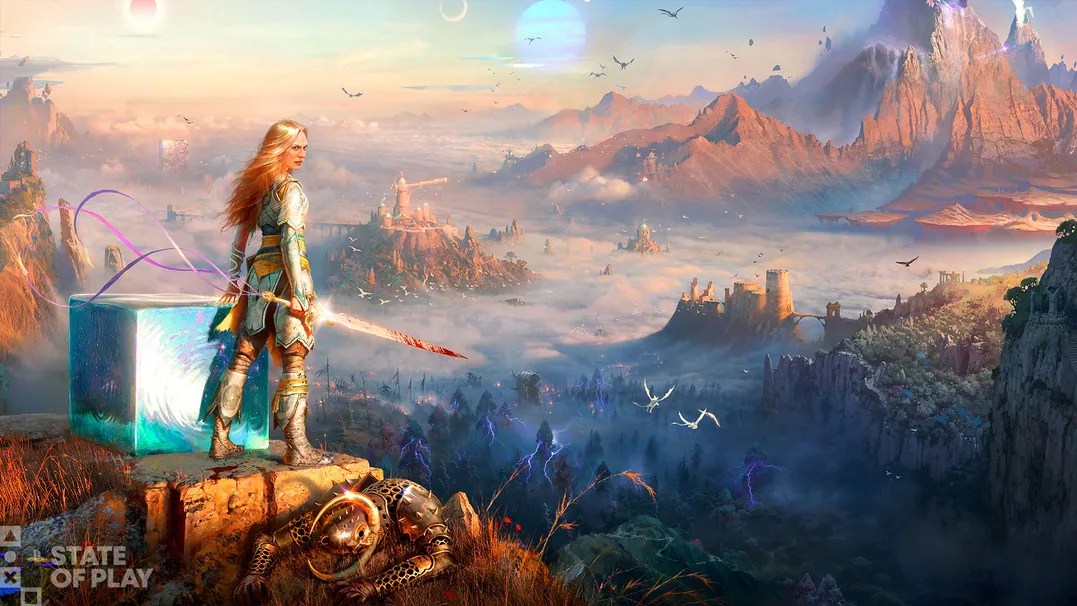
God of War: Laufey was announced at State of Play and poses a lot of interesting questions, like can you have a God of War game without the god of war? Instead, We’re playing as Faye, Kratos’ badass wife and the original owner of the Leviathan axe. While Kratos is a hulking brute of a fighter in the new games, Faye is agile and fast and a little flashier than her husband. Do the fans even want this? Why is there a talking ribbon attached to a sword? Was Fraye the one who blew the horn in God of War 2018? If a god dies and Kratos wasn’t around to do it, does it even count?
All very important questions. All shall be answered in the fullness of time. But the most interesting aspect of what we saw isn’t Faye herself, or finally getting to see how skilled a fighter she is after all of the praise Kratos has heaped upon her over the years. No, it’s the Everywhen, the name given to the afterlife Faye finds herself trapped within. What happens when gods die? God of War: Laufey finally answers that question. They don’t truly disappear.
The first reason this is so interesting is that it allows Santa Monica Studio to blend mythologies together in a way the series has never done before. Previously, God of War largely focused on one mythology at a time. First it was Greek mythology, then Norse. The Everywhen changes that because it acts as the ultimate melting pot, a place where gods from every mythology eventually wind up when death comes calling.
According to Santa Monica, the Everywhen isn’t simply another location like Midgard or Helheim. Instead, it exists as “this transcendent place above the mortal world and the afterlife of humans.”
We see this almost immediately through two of the game’s major antagonists: Sekhmet, the Egyptian goddess of war and healing, and Begtse, a Mongolian god of war. Not only do these characters demonstrate how God of War: Laufey intends to mix different mythologies together, they’re also surprisingly deep cuts. Santa Monica could have reached for more recognisable names from Egyptian mythology, but instead seems determined to cast a wider net and explore cultures that haven’t traditionally received much attention in blockbuster games.

What’s particularly clever about the Everywhen is that it also solves a problem Santa Monica was eventually going to run into. Kratos has spent the better part of two decades treating pantheons like an all-you-can-eat buffet. By the end of the Greek saga, most of Olympus was dead. By the end of Ragnarök, the Norse gods weren’t exactly thriving either.
Until now, every new God of War game needed a new mythology to explore. Egypt. Japan. Celtic mythology. Wherever Kratos might wander next. The Everywhen changes that. Instead of moving sideways into another mythology, Santa Monica has created a place that sits above all of them. According to the developers, it’s where all magic returns and where gods go when they die. A single realm where every pantheon ultimately converges.
As Cory Barlog explained, the goal is that “it all connects to each other. It all influences each other.” Suddenly the Greek era, the Norse era, and whatever comes next no longer feel like separate stories. That means the franchise is no longer limited to telling Greek stories, Norse stories or Egyptian stories. It can tell all of them at once.
The real reason the Everywhen intrigues me, though, is because it’s exactly what it claims to be: an afterlife for the gods. All of them. Just take a second to think about that.
If the rules apply equally to every deity, then Zeus, Ares, Hades, Poseidon and a whole host of Kratos’ former enemies should be somewhere out there in the Everywhen.
“Thrusting all these gods into a singular space in which they cannot escape is this recipe, this powder keg,” Cory Barlog told IGN. That’s a lot of very big egos and a lot of old grudges.

Kratos may have accidentally become one of the Everywhen’s largest contributors. Zeus is there. Ares is there. Hades is there. Baldur is probably wandering around somewhere. Heimdall is undoubtedly still being insufferable. Depending on how the rules work, there could be enough former Kratos victims in the Everywhen to start their own support group.
“My name is Zeus, and Kratos killed me.”
“Hi Zeus.”
“My name is Baldur, and Kratos killed me.”
“Hi Baldur.”
“My name is Heimdall and…”
“Yeah, we know.”
It’s entirely possible that Faye never encounters any of them. The Everywhen sounds vast, and Santa Monica hasn’t hinted at any returning characters. Plus, the term “Everywhen” makes it sound like this place exists outside of regular space and time, sort of like the DVLA. But that seems almost impossible to imagine. When you’re developing a concept like this, one of the very first thoughts has to be: what happens when Kratos’ victims all end up in the same place?
To create a realm populated by dead gods and then never use it to revisit any of the franchise’s fallen legends would be like holding a fresh sugary doughnut in your hand and choosing not to eat it. Technically possible, I suppose. But also completely insane. Who would do that? What kind of maniac?
More importantly, though, the most interesting outcome isn’t seeing Zeus or Baldur return. It’s seeing what happens if they do.
Modern God of War has largely been about Kratos confronting the consequences of his actions and trying to become something better. He’s spent two games wrestling with his past, attempting to break the cycle of violence and teaching Atreus not to become the man he once was. Behind him is a trail of dead deities so wide that entire religious texts need edited so that the final line says, “And then fucking Kratos happened.”
But what if the consequences finally catch up with him anyway? Only not through him. Through his wife.
Imagine introducing yourself as Laufey and watching the mood in the room change the moment somebody realises exactly who you’re married to. Imagine spending eternity trapped alongside gods whose only common bond is that your husband murdered them. Some deserved it. Many absolutely had it coming. But I suspect that distinction becomes less important when you’ve spent a few hundred years dead and angry. Gods tend to hold grudges in this franchise.
Kratos getting punched in the face by the consequences of his actions would feel almost expected. That’s the sort of tragedy he’s been carrying since the original game. Faye being forced to deal with them instead? That’s cruel. That’s personal. That’s exactly the kind of emotional gut punch modern God of War loves to deliver. That’s the kind of consequence that would drive the mighty Kratos to his knees.
The Everywhen feels like far more than a backdrop for Faye’s story. It feels like Santa Monica quietly building the future of the franchise. A place where every mythology can collide, every story can connect, and where the consequences of Kratos’ twenty-year-long rampage might finally catch up with him again.
The only difference is that Kratos might not be around when they do.
His wife will be.
She isn’t the God of War.
She just loved the God of War.
